3103.
I am a kid of the TV age, for better and for worse and for all that this implies.
There are good sides to that. TV introduced me to the my Other Woman, the Other Love Of My Life: the city of Portland. Unlike most, at least I can say I’m a native Oregonian, but if I had it to do over again, I would that my Mom and Dad lived up here.
I’d say we’d have been a good fit in Montavilla. As it is, I live in Greater Russellville, so at least that worked out.
 But TV studios, for me, is where a lot of magic occurs. It is a kind of temple for me. I never got the chance to be on Ramblin’ Rod, like a lot of my fellow kids did, nor even ironically, as a young adult. And when I finally became a Portlander full-time, one of the first things I did was go around to all the TV stations … KOIN, KGW, KATU, KPTV … and just get a good look at them. To say I’d been.
For a time, I lived on SE 8th Avenue just south of Powell Blvd. That was the time before whoever owns KPTV bought it and moved it out to Beaverton, when it had that beautiful building, resplendent with the big neon 12 in the tower at the corner of the building. There was an ineffable satisfaction in living within a half-mile of the station that gave me Perry Mason so faithfully.
 That, as they say, was then … though it looks much the same from the front end, ownerships have changed, philosophies have changed. There isn’t even a Fisher Broadcasting any more. But the big guns are still stalking the streets of our now two-horse town (I believe we upgraded from one-horse sometime in 2007) and they still generate fascination and I am still mad curious at what it looks like behind the scenes. So, when KGW NewsChannel 8 said we could all come down and get tours of the Studio On The Square, in Pioneer Courthouse Square well …
 It was from 10 AM to 2 PM last Saturday, the 31st. Arriving at the Square itself we saw, laid upon it, a labyrinth of colorful flowers, a hypnotic pattern. It’s the annual Festival of Flowers, and this year, they’ve decided on a labyrinth design with a graphic pattern celebrating the Square’s 30th anniversary. It’ll be up until the 10th of June, and I understand you can buy the blossoms as the event wears on. But that, as mentioned, was not why we where there … well, not the main reason. It did give the eye something delightful to linger on as we waited to get in.
This was a day to be somewhere as early as you could. Not only was the weather strictly beautiful, a wonderful Oregon Spring day where the sun was bright, it was warm and not too warm, and not too humid, so waiting outside wasn’t an ordeal. Now the Studio On The Square is on the southeast corner of the Square, near the intersection of SW 6th Avenue and Yamhill Street. A big window looks out onto a stairwell that leads up to the ground level of the Square itself. On the level over the studio, the roof, was arranged a long shelter so that those who came could wait out of the direct sun.
It was needed.
 |
| Looks like they’re gonna need a bigger boat. |
We stood by in a line while we were taken down in groups of 30 at a time. They were neat and organized and precise … they knew what sort of fanbase they were dealing with here. In the meantime, a familiar face came out to enjoy some sun and some coffee:
That’s KGW’s Wayne Havrelly, whom we rather enjoy. You see him on weekends mostly, and doing reporting during the week.
The news cameraguys were out in force, and there was a bit of a moment of recognition between two documentarians … one, professional, the other, yours truly, self-made. Still, I felt a bit of solidarity here …
 |
| iSeeYouSeeingMe |
… and the chance to get a picture of someone taking a picture of you taking a picture of them taking a picture of you should never be passed up. It was a cool moment and I know it was, because just as he took down the camera, he gave me a peace-sign.
Dude, that was most cool of you.
We were admitted, finally, to the area under the Square through the door on the right of the studio window. While we waited for the previous group to clear out we had one of the producers tell us all about the Square, point out the videos that were running on the screens beside the big window in, and get us all ready and enthusiastic about it (we all brought our happy, there wasn’t much priming to do there). Meantime, somehow, that Havrelly fellah slipped back into the building and had to slip past the madding crowd to get back out. Here, I caught him as he got past us.
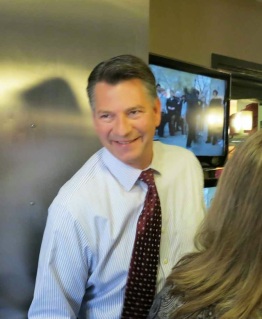 |
Yes, Virginia, there is a Wayne Havrelly.
He’s pretty hard to pin down, however. |
At last, in … now, I do know something of the history of this space. Five years ago, before it was KGW’s Studio on the Square, it was a branch of the Powell’s Books empire … Powell’s Travel Store. It stocked maps, travel guides, travel accessories … it even had a currency exchange counter. I loved it because you could find city maps from all over the USA of small towns that you’d never heard of. When the Travel Store closed, those items removed to just off the top of the store in the Red Room, until the stock was depleted, and that is now history.
 But they’re making history of their own in the space that used to be the Travel Store. And one other thing. When that space was planned, I’m certain they did not envision it to be a television studio or anything like it. Now, when you look at the set, with Brenda and Russ behind the desk, it has a certain size to it.
You enter this studio, and you and the thirty other lucky Golden Ticket winners and the newsies within are all there … and it feels tiny. Just to the left, as we came in, were all the computers that the weather ‘casters use to put together the reports. Less than ten feet away, on the right from that, is a big green wall in front of which the weather ‘caster stands. Less than ten feet away from that is the anchor desk.
This was once a smallish bookstore. Now, it’s a smallish TV studio. It’s a bit like the TARDIS, in a way; it’s bigger on the inside, but only on TV.
This next photo gives an very good idea of the size of the set. There, on the left is morning anchor Russ Lewis; on the right, signing an autograph, is morning weatherguy Nick Allard. Now, Russ is about average height, and Nick is tall (well, not Steve-Dunn-tall … that guy’s a freakin’ Sequoia). And you can see how close the overhead lighting and how wide that anchor desk really is.
It felt about the size of your average dinner table.
And one thing I noticed about Nick Allard … with fashionably-stubbled visage, he bears a striking resemblance to Wil Wheaton. Seriously. He looked just like him!
Remembering back to our experience at KOPB last month, where it was a leisurely, self-guided tour and you could chat as long as the personalities had time, very laid back, this was like speed-dating. And that’s no sin on their part … they were swamped with people who just wanted to see the people they liked on the news and get a look at the place they worked at. All the KGW newsies were very sweet and very affable, and up for as many photos as you wanted to take with them.
Shepherding us fans through there must have been like herding cats. And KGW has lots of Portlanders that love them; when we got there, the line just barely fit under the shelter. By the time we left the studio, it extended almost all the way back to the corner of Broadway and Yamhill.
We Portlanders love our newspeople. And I’ll bet those newspeople were some tuckered newspeople by the end of this ‘do. God bless ’em. Seriously. I could not keep up with that pace.
 |
Reggie and Steph with a young fan in front
of the weather wall |
And here’s a real look behind the scense … the anchor desk. Below can be seen the computer that runs the electronics built into the anchor’s desktop. The seats were rather comfortable.
 |
| In the distance, with his arms crossed: Nick Allard |
I got to say hi to one … Reggie Aqui. I must say, his aplomb in affably meeting someone who was a little overcome in the crush of people and therefore without his usual velvet wit (that is to say, Yours Truly) I will sincerely be in awe of:
“Hi! I’m Sam.”
“I’m Reggie Aqui”
“I know.”
I could write speeches for the President, genius, SHEER FREAKING GENIUS!!!
One more picture for now. This is what the Studio on the Square looks like to Brenda or Russ every morning.
About the size of a medium size classroom. I recall when
KATU invited a bunch of us bloggers over to the studio a while back, and I got the first look I ever had, in real life, of a television studio. I was astounded. Not only did KATU vid the news there, but on the other side of the studio was the set for AM/NW. That studio was a very large room but you cram two shows’ sets in them and all of a sudden it becomes very small; even the seats for the AM/NW audience were in there, hidden behind a curtain. But it’s all in the way you frame it.
That guy in the lower right corner there? Stalker. Has to be.
I’d suggest a restraining order. Otherwise, you’ll have nothing but fans tromping through the studio all the time.
Don’t know what gave me that idea, but there it is.
Thanks for the peek, KGW. You guys rock.
 My backpack has been part of my identity for a long time. It holds a lot of things that are important to me that I want to keep near; the sketchbook I’m not drawing in; the book on creativity I’m not reading or using, the art supplies I’m apparently hoarding up against the apocalypse. But backpacks encourage a sort-of hermit crabbish-ness, in which I carry my notional studio on my back. As long as my right shoulder isn’t killing me (how I’ve avoided tendonitis all these years, I can’t tell you) I figure I can carry anything. Or everything.







 The ZehnKatzen Times